SUSTAINABILITY
- Home /
- Sustainability /
- Environmental Initiatives
Environmental Initiatives
In 2021, the SOLIZE Group added “Realize Intrinsically Beautiful Manufacturing” as a new mission in pursuit of harmonious coexistence between the global environment and humanity and the realization of a circular society. This mission envisions manufacturing that exists in balance with human society and the global environment, from development and production through consumption, disposal, and reuse.
Carbon Neutrality Target
To contribute to the realization of a decarbonized society, we have set a target of achieving carbon neutrality by FY2030 for greenhouse gas emissions from the SOLIZE Group’s business activities, covering Scope 1 and Scope 2.
In 2021, we added “Realize Intrinsically Beautiful Manufacturing” as a new mission in pursuit of harmonious coexistence between the global environment and humanity and the realization of a circular society. This mission envisions manufacturing that exists in balance with human society and the global environment, from development and production through consumption, disposal, and reuse. As part of this effort, we are working to reduce CO2 emissions from our own business activities.
Our target and specific initiatives to achieve it are as follows:
- Target Achieve carbon neutrality by 2030 for greenhouse gas emissions from our own operations, covering Scope 1 and Scope 2.
-
Specific Initiatives to Achieve the Target
・Introduce ZEVs(zero-emission vehicles, such as electric vehicles and fuel cell vehicles) as company vehicles
・Switch electricity used at business sites to renewable or virtually renewable energy
・Promote initiatives to improve energy efficiency
Switching Electricity Used at Global Engineering Center-Yamato / Yamato Factory to Virtually Renewable Sources
The Sanki Yamato Building, a multi-tenant office building in Yamato city, Kanagawa prefecture that houses our Global Engineering Center-Yamato and Yamato Factory, has used virtually renewable electricity under the Green Basic Plan*1 provided by TEPCO Energy Partner, Inc. since April 2022.
The building provides an electricity-use scheme that enables renewable-energy conversion for tenant-occupied areas as well. By using this scheme, we switched the electricity used at this site to virtually renewable energy in January 2023.
- *1 Green Basic Plan: A virtually renewable electricity plan compatible with RE100* 2 that combines electricity from the average power source mix with FIT non-fossil certificates with tracking and non-FIT non-fossil certificates designated as renewable energy with power source attribute information.
- *2 RE100: An abbreviation of “Renewable Energy 100%,” an international initiative whose goal is for companies to procure 100% of the electricity they use in their business activities from renewable sources.
Introduction of the Fuel Cell Electric Vehicle (FCEV) MIRAI at Toyota Factory
In October 2023, we introduced Toyota Motor Corporation’s fuel cell electric vehicle (FCEV), the MIRAI, as a company vehicle at Toyota Factory. The MIRAI is equipped with a fuel cell that drives the motor using electricity generated by the chemical reaction between hydrogen and oxygen in the air, resulting in zero CO2 emissions while driving.
We have also introduced one Nissan LEAF electric vehicle (EV) at Global Engineering Center-Yamato.

ISO 14001:2015 Environmental Management System Certification
 JQA-EM7634
We have obtained ISO 14001 certification, an international standard for environmental management systems established by the International Organization for Standardization (ISO).
As professionals in manufacturing using 3D printers, we recognize the importance of protecting the global environment. Through activities such as parts production, manufacturing process proposals, 3D printer sales, and startup support, we will continue conducting environmentally conscious activities and work to reduce environmental impact.
Reuse of Waste Plastic from 3D Printer Factories
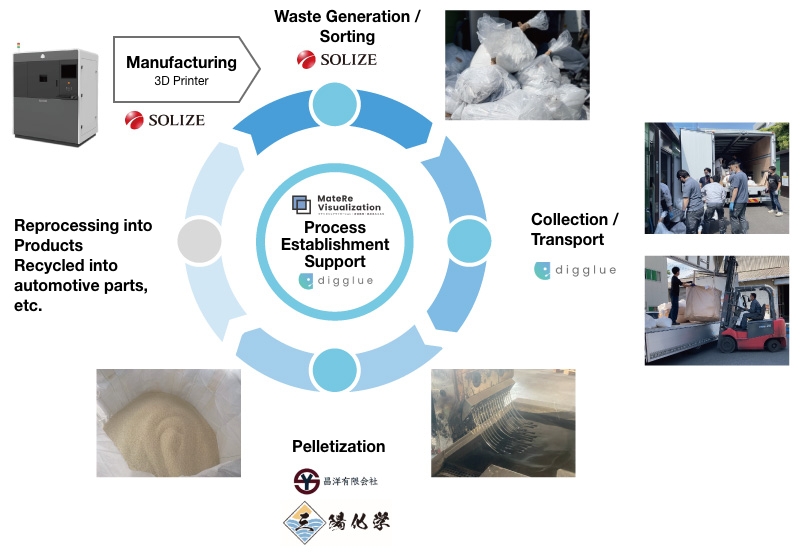
As part of our environmental management activities, we are working to reduce industrial waste. For 3D printer materials, we have established processes to reuse as much material as possible while ensuring quality. However, a certain amount of powdered plastic still had to be discarded.
To reduce waste, we worked with digglue Inc., the developer of MateRe, a resource-circulation information platform, to pelletize powdered plastic, and began using this process at Yamato Factory in 2023. In 2024, we expanded the scope of application to Toyota Factory, and we are now able to reduce the previous disposal volume by approximately 70%. The recycled pellets are also used as raw materials for automotive parts, and we are advancing initiatives to reuse the remaining waste plastics using 3D printers.
Promoting Environmentally Conscious Design
To achieve carbon neutrality and realize a resource-circular society, product design methods themselves must also change. As regulations on CO2 emissions and carbon pricing mechanisms such as carbon border adjustment continue to be introduced, environmental considerations are expected to become as important as function, performance, and cost.
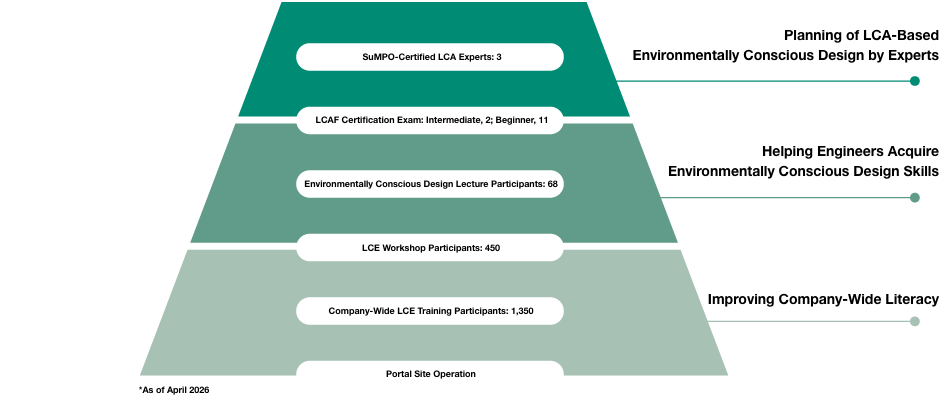
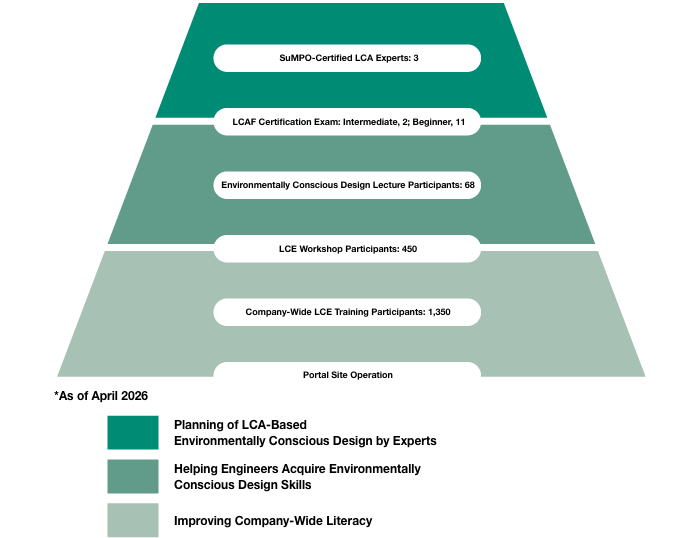
We aim to evolve the approach to environmentally conscious design through ingenuity and creativity, and are actively promoting the acquisition of the skills engineers need to put these ideas into practice. Internally, we provide education on LCE (Life Cycle Engineering) and DfE (Design for Environment) through lectures by Professor Shinichi Fukushige of Waseda University’s School of Creative Science and Engineering. We have also launched the LCE Project to build a mechanism for engineers to learn about, understand, and communicate LCE.
By incorporating environmental considerations from the upstream design stage, we are advancing initiatives with partner companies to address the difficult challenge of achieving a carbon-neutral world.